February 18th, 2015 at 11:43 am 
Most organizations cannot eliminate ALL of the overtime without sacrificing production or service levels. There are three situations in which overtime is going to be necessary: (1) the work volume temporarily increases, (2) a position is vacant, or (3) someone is absent (vacation, illness, training, etc.). I refer to this as overtime incurred outside the normal work schedule.
Sometimes it's possible to reduce overtime by swapping where it occurs. If you increase the overtime within the regular work schedule (e.g., by increasing the average hours of work from 40 to 42 per week), it may be possible to reduce the need for overtime outside the schedule. In some cases, the total overtime will be reduced.
I know, you're going to argue that overtime should be given to those employees who want it the most and volunteer for it. That's fine - up to a point. But when the overtime becomes excessive or when it continues so long that employees become addicted to it, then it's a problem. Or when you run out of volunteers and have to rely on mandatory, forced overtime to achieve or maintain the desired coverage levels - that's not good.
Here are two examples that illustrate the benefits of increasing overtime in the schedule to reduce overtime that occurs outside the schedule.
Example #1
A police department needs two people working at all times on a 24/7 basis. They are using 9 officers with an 8-hour rotating shift schedule because they don't want any overtime in the schedule. The problem is, like most law enforcement agencies, they have a high absence rate which causes their overtime to bust the budget.
If they built a small amount of overtime into the schedule, they could free up enough capacity to have a full week of relief coverage. They would need a 9-week schedule in which 8 weeks were devoted to the required coverage and 1 week was devoted to relief coverage. All 9 employees would share the relief responsibility equally. With rotating shifts, this relief coverage could be used to cover absences on any shift. It doesn't mean the relief employee would work all week; it simply means they are on-call for that week. If someone was scheduled for vacation, the relief person would work the vacationer's schedule that week and nothing more. If no one took vacation, the relief person could work a Mon-Fri day shift or go to training or work on a special project.
So the tradeoff is 2 hours of overtime for all 9 employees every week (18 hours of total overtime) in exchange for the flexibility to cover 40 to 48 hours of absences a week. Granted, someone won't be on vacation every week, but isn't it compelling to use 18 hours of OT in the schedule to avoid an average of 42 hours of OT outside the schedule? And think of the time saved trying to find volunteers to cover any absences, or the aggravation of forcing a junior employee to do a couple of double shifts when no one else volunteers.
Example #2
This example comes from a company that I designed schedules for earlier this week. They have 8 employees and need 2-person coverage at all times on a 24/7 basis. This would be simple if the 8 employees worked an average of 42 hours a week. The problem was that upper management would not approve a schedule with overtime in it. So I created three schedule options using a combination of 12-hour and 4-hour shifts. The 8 employees will have to work three 12-hour shifts and one 4-hour shift or 40 hours every week.
Although the schedules had no overtime in them, there were two 8 hour periods with only 1-person coverage instead of the desired 2-person coverage. The good news is that the organization had three supervisors to fill these open slots. The bad news is that the supervisors already had a tough time trying to be available on a 24/7 basis. When you added the two extra shifts plus relief coverage for all the other absences including their own, the supervisors were working way too many hours a week and were burned out.
I recommended that the client hire one more employee and have the 9 employees work a 12-hour schedule that averaged 42 hours a week. This would have allowed them to build a full week of relief coverage into the schedule. There would be no coverage gaps and a lot less need for OT to cover absences. I was unable to convince them that was the best solution. And believe me, I gave it my best shot. I'll probably hear from them again when the supervisors start bailing out for more attractive work environments with other employers. It's too bad that management's desire to avoid overtime in the employee's schedule is ruining the job for the supervisors. Replacing those supervisors is going to be a lot more expensive and painful.
|
December 29th, 2014 at 1:34 pm
When organizations struggle to make ends meet, overtime often becomes a target in their budget reduction plans. Although reducing overtime may be financially prudent for most departments, it is a poor choice for those that operate around-the-clock. Here's why.
The simplest and most common way to provide 24/7 coverage is with four crews. If the crews work 40 hours a week, that provides 160 hours of coverage (4 crews * 40 hours = 160 hours). The problem is that there are 168 hours in a week (24 hours * 7 days = 168 hours).
The easiest way to close the 8-hour gap is to have the four crews work a small amount of overtime (an average of two hours per employee every week). With 8-hour shift schedules, that requires three hours extra pay for each employee, or a 7.5 percent increase. With 12-hour shift schedules, that requires four hours of additional pay for each employee, or a 10 percent increase.
If an organization is prohibited from using overtime, it must choose one of the following approaches to avoid gaps in coverage:
1. Use part-time employees. Some smaller organizations can do this, though it can be a challenge to find and retain good part-time employees. With larger groups, it can be difficult to fit part-time employees into the schedule without having one shift staffed solely with part-timers. This approach will increase costs by 5 percent. Although slightly less expensive than using overtime, it has limited applicability.
2. Use more than four crews. A schedule that uses more than four crews requires a larger headcount. If an organization does this, they usually allocate some of the extra work hours to training, relief, maintenance or special projects. Even if you ignore the cost of benefits for the additional employees (usually anywhere from 40 percent to 50 percent of the wages), this approach will increase costs by at least 25 percent.
3. Use a crewless schedule. Instead of scheduling groups of personnel (i.e. crews), you could develop a schedule for each individual employee. This approach also will require more employees than a typical four-crew schedule. The number depends on: (a) the shift length, (b) whether the shifts are rotating or fixed, and (c) the number of job categories/positions involved. This can increase costs anywhere from 7.7 percent to 50 percent if you ignore the cost of benefits. In most cases, this approach will cost more than using a four-crew schedule with built-in overtime.
Although overtime is often perceived as something to be avoided (because it requires a time-and-a-half pay premium), it is not the most expensive approach for providing 24/7 coverage. Using part-time employees to supplement four full-time crews is the least expensive solution, but this is only feasible in smaller groups. So, before banning overtime, it is important to recognize that the policy will force groups that operate around-the-clock to adopt schedules that are actually more expensive.
When organizations view overtime as an expense rather than a strategic tool, they often make three major mistakes:
- They staff for peak demand. In order to have enough resources on hand to respond to short-term fluctuations in demand, they over-staff instead of using overtime. Usually this is the most expensive approach.
- They sacrifice customer service. Without overtime, they are unable to respond to fluctuations in demand. In short, they sacrifice customer service to avoid overtime.
- They build up an inventory of excess product to have a cushion for demand variations. The cost of this inventory must be passed on to customers.
Here are three more articles on overtime.
Reasons for using overtime. Four valid reasons for using overtime are: (1) 24/7 coverage, (2) workload fluctuations, (3) staff variations, and (4) labor market considerations.
Overtime problems. High overtime, especially when it continues for an extended time period, has several potential drawbacks: (1) an overtime-dependent workforce, (2) safety and quality issues, (3) absenteeism, and (4) lower productivity.
Correcting overtime problems. To avoid overtime problems, you should regularly monitor overtime and absences. You also should understand the workload variations and take steps to improve the accuracy of your demand forecasts. Periodically, you should review your organization's overtime distribution policies to make sure they are working properly.
|
June 11th, 2014 at 3:24 pm
Most people think of work schedules as merely an on-off pattern for a specific shift length, for example, a 5-on-2-off pattern for 8-hour shifts or a 2-3-2 pattern for 12-hour shifts. While it's true that the work pattern and shift length are essential components of the schedule, they are not necessarily the most important and definitely not the best place to start the search for a new schedule. What? How can I say that? Let me explain.
When people search for a new schedule, they often forget about its primary purpose. It's not to give employees 40 hours a week. It's not to give employees more days off each week or more weekends off. No. The schedule is there to make sure the organization always has the right number of people at work. Let me re-emphasize that point: the primary purpose of the schedule is to match the coverage with the workload.
In smaller organizations where the workload isn't constant (e.g., it's lower at night or on the weekends), it's critical to schedule more employees to work when it's busy and fewer employees to work when it's slow. I can't tell you how many times I've had inquiries in which the person says they need 3 people for 16 hours and 1 person for 8-hours a day, but they wanted to change to 10 or 12-hour shifts. When I try to explain that these longer shifts don't match their workload distribution, they get indignant and say something like, "The employees are unhappy with the current schedule, so we're looking for a schedule that will give them more days off. If you can't help us, we'll find someone who can."
This may not be an issue for large companies that have a steady workload around the clock. But with smaller organizations (less than 50 employees), it's often critical. And it applies to a variety of industries. You'd be surprised to hear the types of businesses that I've recently done schedules for - restaurants, auto dealers, and hair stylists. These are not typical shiftwork operations. Yet they all need to align their staff with the changing volume of work, whether it changes by hour of the day or by day of the week (or both).
Let's take a closer look at a simple example: the mechanics at an auto dealer. Their service department is open 6 days a week (Mon-Sat) from 7 a.m. to 5 p.m. (10 hours a day). There were 15 mechanics altogether. The workload is highest on Friday and Saturday. I assigned the staff to 5 crews of 3 each. Here is one of the schedules I came up with:
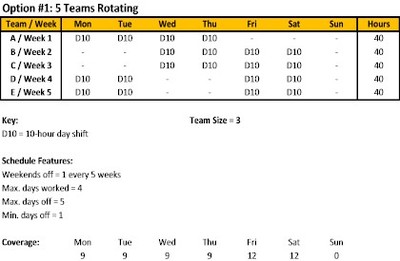 |
Here's how it works. Team A is initially assigned to Week 1 of the schedule. They work 10 hours on Monday through Thursday that first week. When that week is done, they drop down to the second week of the schedule. For this second week, they work 10 hours on Wednesday through Saturday. They then begin the 3rd week of the schedule, followed by the 4th and 5th weeks. Once the 5th week has been completed, they go back to Week 1 and start the 5-week pattern over again. All 5 teams are working the same schedule; they are merely in different weeks of that pattern.
The mechanics will naturally be most concerned with the schedule features listed below the schedule. As you can see, they will get one full weekend off every 5 weeks. They will have to work a maximum of 4 consecutive days. They will get 5 days off in a row (Week 1 into Week 2). Several times over the 5-week cycle, they will only get 1-day breaks (Sundays). Although they don't get many weekends off, they do get more days off than they would with an 8-hour schedule.
The manager's primary concern is the coverage that the schedule produces. Three teams (9 mechanics) are scheduled to work Mon-Thu and four teams (12 mechanics) are scheduled to work Fri-Sat. We could have shifted more coverage to the two busy days, but the manager wanted the mechanics to have at least one weekend off. He was not happy with the 5-day break, since that would leave unfinished repairs for too long and the employees might forget what work they had completed in the prior week. To satisfy this concern, I revised the schedule by rearranging the weeks so that the longest break was only 3 days in a row.
The key point of this example is to demonstrate the importance of starting the schedule design by examining the workload and coverage requirements rather than starting with a desired shift length and work pattern. Had we started with a 4-on-3-off pattern, the schedule might have looked like this:
Unlike the previous schedule, the teams don't rotate to a different set of days each week. Instead, they always work the same 4 consecutive days and get the same 3 days off. This is great for Team A, which gets a 3-day weekend off, but not so great for the other four teams that have to work every Saturday. Most people probably would tolerate this because they are getting 3 consecutive days off. The big loser with this schedule is the organization. Although there are sufficient mechanics working on Fri and Sat, there is only one team working every Mon and Tue, and 5 teams every Wed and Thu. No matter how you juggle the weeks or the patterns around, you can't avoid problems with the coverage.
If you start the schedule selection process with a specific work pattern in mind, the resulting schedule may be acceptable to employees but detrimental to the organization. In our example, the organization would have been understaffed 2 days a week and overstaffed 2 days a week. If you start the process with the coverage requirements and use rotating days of work, you can optimize the coverage and give employees a decent schedule that treats everyone equally. In our example, the coverage was perfectly matched to the workload and the employees all get one long weekend off every 5 weeks.
|
June 10th, 2014 at 4:00 pm 
Even when employees understand the need for the employer to change from operating 5 days a week to 7 days a week, they aren't very receptive. Yes they are fed up with regularly working 6 days a week and sometimes all 7 days. Even though they will get more days off (and more full weekends off) on a 24/7 schedule, they resist the change.
I thought you might like to read some of the typical comments from employees facing this major change:
- If we choose to go to 12-hour shifts, will everything over 8 per day still be overtime or will it change to only being over 40 hours a week?
- Seniority and how the people working those new shifts will be selected. Vacation/personal days (how they work). Holiday pay. Coverage of shifts for call-outs, sick days and vacation. Do we still get paid for not taking a lunch break? If we work 12-hours, how does that work?
- How will working a 24/7 work week will affect the wear and tear on the equipment used on a daily basis?
- Can this be done with an 8-hour shift? Does everyone have to work 12 hours?
- What about those of us who need all the OT we can get because our bills can't be paid without it? Do we get a second job?
- If I would have to work the overnight shift, everything in my life will be affected. I would also hope my pay to stay the same or get better.
- Overtime is very important to ALL of us because a lot of us are under-paid and need it to make ends meet. So please keep that in mind as well.
- The fact that we are being forced to make a decision that increases the company's profit, and in turn we have to bend over backwards to do it and get no sort of compensation to do it. It's bullshit and greedy.
- How does seniority relate to any of this?
- I understand the reason for 24/7 operation. However, this process to me is just another way management confronts challenges/issues. In short, the management team does not address the core problem. Rather they address the symptoms of the core problem.
|
June 2nd, 2014 at 12:58 pm
If you manage a business that is considering the idea of expanding to 24/7, you may be wondering how your employees will react to the change. You can expect most employees to focus on the loss of weekends off and the loss of overtime. This is despite the fact that they are already working every Saturday and some Sundays, and even though most 24/7 schedules have some overtime built into them.
Employee responses often depend on how the question is asked. If you simply ask whether they would mind working the weekends, you can expect the answer will be, "No way!" If the question is reframed to whether they would like 10% more pay and 78 more days off annually, you would probably get a completely different response. Responses also will be based on their specific concerns, such as the following:
- Employees may not understand or appreciate the economic and competitive reasons for running the business 7 days a week. Larger organizations often prepare a business case that discusses reasons for the change. You may not need to be this formal, but you must clearly explain and justify the need for a 24/7 schedule. Lacking a compelling reason for making this change, employees will assume the worst. Management is doing this to get rid of people they don't like. Management doesn't care about the workers or their families. Management is doing this to bust the union. Management is doing this for their convenience, etc., etc.
- Employees may be concerned about the unknowns of a new schedule. It's important to give them as much information as possible: days off, weekends off, maximum consecutive days of work, maximum consecutive days off, minimum consecutive days off, pay impact, paid time-off (vacations, holidays, bereavement leave, etc.) impact, and so on. They may need time to digest this information, so don't rush it. While there is no way to eliminate all the unknowns in advance, you should tell the workforce as much as you can. If you can know the absence rates and can estimate the overtime requirements, show them. If you are planning to change the vacation or holiday policies, let them know.
- Employees may misunderstand 24/7 schedules. When told the company will operate 7 days a week, they mistakenly think they will have to work every day of the week. They may have friends who are shift workers who have told them horror stories about 24/7 schedules. You will need to show them several different schedule examples and compare the number of days off, weekends off, and pay vs. the current schedule.
I highly recommend following a strategic schedule selection process. I have described this process elsewhere on my website. Here's a link: http://www.shift-schedule-design.com/Schedule_Selection_Process.
|
May 30th, 2014 at 1:30 pm
When businesses grow, they sometimes reach a point where the managers start to think about working 7 days a week, i.e. a continuous 24/7 operation. Here are some of the common reasons they decide to make this change:
- The cost of starting and shutting down equipment on the weekends is expensive. Although this weekly shut-down may provide an opportunity for maintenance, it also can result in the loss of product and unnecessary cleaning costs. In food processing plants, for example, any product left in place when the equipment is stopped will spoil or clog up the machinery. By operating continuously, these weekly clean-up costs can be avoided.
- The cost of acquiring additional equipment is too high. It's cheaper to maximize the output from the equipment you already have. This means running it for as many hours as possible each week, including weekends.
- The company has run out of space. This applies to businesses that aren't typically thought of as shiftwork operations. For example, an office that has out-grown it current space may find it cheaper to operate multiple shifts and / or 7 days a week to avoid moving to a larger space or moving part the workforce into another facility.
- To be competitive, companies want to fulfill orders as quickly as possible. If they are closed on the weekends, this delays the fulfillment process and may cause customers to seek other vendors that promise faster delivery. With a 7-day schedule, orders can come in on Thursday or Friday be filled on the weekend rather than waiting until Monday.
- If production works 7 days a week, this can reduce the amount of goods in storage. Since shipping normally occurs on weekdays, inventory can be allowed to run low during the week and replenished by the weekend production.
- In tight labor markets, offering a 7-day shift schedule for at least part of the company can attract employees who want more days off each week and the higher pay found with 24/7 schedules.
I'm sure there are other reasons for adopting a 7-day schedule. In most cases, it is a combination of several issues and cost considerations that drive the decision.
|
May 22nd, 2014 at 2:30 pm
Employees and management see shift schedules from entirely different perspectives. When employees discuss their ideal shift schedule, they talk about things like shift length, work patterns, and shift start/end times. That's because these features are related to their primary concern: time off.
- Shift length affects the number of scheduled days off and percentage of weekends off.
- Work patterns influence the length and frequency of the breaks.
- Shift start/end times determine when they get to go home.
When managers of shiftwork operations discuss the organization's shift schedule, they are primarily concerned about the coverage requirements, staffing levels, absence rates, and overtime. That's because these features affect their main concern: the organization's resources.
- Coverage requirements define the amount of resources needed (total work hours per week).
- Staffing is the primary resource available to the organization.
- Absence rates determine the staff's availability and the amount of overtime needed.
- Overtime is seen by some as an unnecessary cost and by others as a strategic tool to boost the weekly work hours and/or cover absences.
Employees rarely consider the impact of their preferences on the organization's resources. Go to any employee forum and read the posts related to work schedules. You'll read about a group that adopted 10-hour shifts and how all the employees love them. Or how another group thinks a 6-on-3-off pattern would be better than the 5-on-2-off pattern they work now - because of the 3 consecutive days off. You also might find requests for a copy of someone else's schedule. No one ever mentions coverage requirements, the impact on absence coverage, or how many employees these choices would require. It's all about days off, weekends off, or not having to work too many days in a row.
So how can managers accommodate both the needs of the organization and the preferences of the employees? The only way to satisfy both sides is to start with what's feasible for the organization, and then seek out options that will satisfy employees. If you start with what employees want, you might get inconsistent or insufficient coverage, coverage that's not matched with the workload or staff size, or schedules that consume more resources than available.
Notice that I'm only indicating where to begin the search for a new schedule. Starting with what is feasible may narrow the scheduling possibilities or preclude certain approaches, but it doesn't mean the employees will have terrible schedules. And it doesn't mean they won't have any choices. What it does is join the management team with the workers in finding a solution that is best for both the organization and the employees.
|
May 16th, 2014 at 10:24 am
I had a call from a California company earlier this week that was operating on a 24/5 basis. They expected to go to 24/7 in the next year or two and wanted to take steps now to prepare for the eventual change to a continuous operation. Their current schedule used three 8-hour shifts that rotated every 6 weeks. The shifts started at 5:00 a.m., 1:00 p.m., and 9:00 p.m. They were paying shift differentials for the 2nd and 3rd shifts. They were not represented by a union.
Here is what I recommended:
- Shift length. Most companies that change to 24/7 end up adopting 12-hour shifts. Not all, but a substantial majority. However, since this company was located in California and not represented by a union, it would have to pay overtime after 8 hours a day. This would make 12-hour shifts too expensive, leaving them with no choice other than 8-hour shifts.
- Schedule format. In general, employees prefer fixed shifts while management prefers rotating shifts. Since this company would be using 8-hour shifts, the choice was obvious. 8-hour fixed shifts often require a few more employees than rotating 8-hour shifts, making them a much more expensive choice. Because of this, I recommended that they stay with the rotating shifts. I also warned them that with 24/7 schedules, the employees would change shifts every week rather than every 6 weeks like the are doing now.
- Shift differentials. The purpose of the shift differential is to attract employees to the less desirable shifts. Since the company was using rotating shifts, everyone was working those shifts. There was no need for an incentive. Shift differentials are only appropriate for fixed shifts. With rotating shifts, they are nothing more than a wage increase. To keep the employees' pay the same, the company should replace the differential with an across-the-board pay increase.
- Shift start times. Early start times for the day shift will result in fewer hours of sleep. When you combine this with the rotating shifts, it's a double whammy. I recommended changing the day shift to start no earlier than 6 a.m.
I've run into other companies preparing for continuous operations that were considering transitional changes that would have made the final step to 24/7 much more difficult or that would have locked them into a more costly position. That's why it's important to visualize the key features of the 24/7 schedule in advance, so that the preparatory steps are in alignment.
|
April 24th, 2014 at 1:22 pm
When organizations expand from working 5 days a week to 7 days a week, there will always be someone who suggests hiring a weekend crew. The current employees don't want to work weekends, so why not bring in someone else to do it? That would make the existing workforce happy. Besides, there are plenty of people who would do anything to get a job, even if it means working every weekend. It's a way to get their foot in the door. So everyone wins, right?
Unfortunately, no! There is a big loser, and it's the organization itself. Here are the things we typically hear about weekend crews that have been in place for a year or more:
- The weekend crew has a high turnover since the employees are continuously leaving for jobs with better hours (especially on the night shift).
- The weekend crew has high absenteeism. The weekend job is typically their second job. When they go on vacation from their "main" job, they simply call in sick for their weekend job.
- The weekend crew is out of touch with the rest of the plant.
- The weekend crew personnel move to the weekday crews as soon as there is an opening, which keeps the weekend crew staffed with the newest and least-skilled employees.
- The weekend crew typically performs at about 60% of the rate expected of weekday employees.
- If the weekend crew is also given weekday shifts (to bring them closer to 40 hours/week), the plant becomes overstaffed on the extra days they are scheduled to work.
- The weekend crew often gets a full benefits package. This means a 50% burden rate on the weekday employees equates to a 60-85% burden rate on the weekend crew's hours.
But it gets worse. The weekend crew will continue to under-perform unless the company over-pays. Some companies, in an attempt to improve retention and performance of the weekend crews, may pay 40 hours for 24 hours of work. This can raise the hourly cost of the weekend work to as much as double that of a weekday crew when the cost of benefits is factored in.
Once this becomes apparent (usually within the first 18 months) it's too late. Changing to a true 24/7 schedule will seem like a take-away and the workforce will fight it - tooth and nail. So before you jump at this tempting solution, please read this post one more time.
|
January 26th, 2014 at 12:36 pm
Higher-ranking law enforcement personnel (e.g., Police Chiefs, Sheriffs, Captains, and Lieutenants) tend to look at 10-hour shifts in a different way than their subordinates do. They are well aware of the popularity of 10-hour shifts among the officers/deputies, but often are unable to adopt them due to resource constraints. Let's look at the major considerations in the change to 10-hour shifts from the management perspective.
Overtime
Since four 10-hour shifts add up to 40 hours a week, some people believe 10-hour shifts will eliminate overtime from the work schedule. Unfortunately, this is not always the case as shown below:
| 24/7 Coverage |
Crews Needed
|
Schedule Format |
Average Workweek
|
1 crew
|
5 |
Rotating shifts
|
42 |
| 1 crew |
6 |
Fixed shifts |
40 |
| 2 crews |
5 |
Rotating shifts |
42 |
| 3 crews |
15 |
Either
|
42 |
| 4 crews |
21 |
Either
|
40 |
A crew can consist of one to hundreds of officers. Unlike many 8 or 12-hour shift schedules that require 4 crews, 10-hour schedules require 5 or more crews. For example, to have 1-person coverage around-the-clock, you need 5 people if you use rotating shifts and 6 people if you use fixed shifts. To have 2-person coverage, you would need 10 people (5 crews of 2 each) with rotating shifts and 12 people (6 crews of 2 each) with fixed shifts.
The most common 10-hour schedules rely on 5 or 15 crews. These schedules average 42 hours a week, the same as most 8-hour and 12-hour schedules that use 4 crews. I occasionally get calls from Police Captains and Lieutenants who have tried to create a schedule on their own, but can't make it work. They didn't realize that the schedule needed an occasional 50-hour work week or that it required more crews. Overtime is unnecessary only when the schedule is comprised of 6 crews or 21 crews (and sometimes with a crewless schedule).
Overlapping Shifts
A schedule that uses three 10-hour shifts will have 6 hours a day in which the shifts overlap one another. There are two common ways to use the overlaps:
-
Overlap each shift by two hours. Officers on the out-going shift can do their paperwork while officers on the in-coming shift are out on the street. This ensures continued coverage throughout the day. This approach tends to be preferred by the officers.
-
Align the overlapping shifts with the busiest period of the day. Coverage can be boosted for 6, 12 or 16 hours a day depending on how the shifts are scheduled. I recommend this approach because the primary reason for having a schedule is to allocate the resources to match the workload. The downside is that it often requires unusual shift start/end times. This approach tends to be preferred by management.
Coverage Reduction
The biggest problem with 10-hour shifts is that they require more resources than 8-hour or 12-hour shifts. A 10-hour schedule requires more staff because the officers are working 30 hours a day (three 10-hour shifts). This will either require 25% more personnel or a 25% reduction in the coverage levels. In most cases, headcounts are frozen, so the impact is reduced coverage on each shift.
Even if sufficient staff is available, they are usually needed for other purposes such as absence coverage. Since the absence rates in most police departments are rather high, most Chiefs opt to use any “extra” staff in one of two ways:
-
Increase coverage levels above the minimum. For example, a department needs a minimum of 3 officers on each shift. This requires at least 12 officers working an average of 42 hours a week. They use their staff of 16 officers to provide 4-person coverage. This allows for up to one absence on each shift.
-
Build relief coverage into the schedule. This is often more efficient than increasing the coverage on each shift. For example, the same department only has 14 officers, so they adopt a 14-week rotating shift schedule in which 2 of the 14 weeks are devoted to relief coverage. This requires fewer staff and provides more flexible absence coverage.
When the "extra" coverage is lost, absences (like vacations, sick time, training, court time, etc.) will have to be covered using overtime. This is the most common reason for rejecting the switch to 10-hour shifts. This is such an important point that I have to repeat it. Adopting 10-hour shifts will reduce the coverage on each shift (except for the periods of overlapping shifts). Since part of this coverage provides a cushion for absences, the 10-hour shifts will result in much higher levels of overtime.
Absences
Some people believe that 10-hour shifts will reduce absences. Since the longer shifts provide one additional day off each week, this time can be used for doctor's appointments or other personal business. I am not aware of any studies that confirm this, but it seems possible. The Shift Length Experiment prepared by the Police Foundation did not report any significant reductions in sick leave when switching to 10s (http://www.policefoundation.org/publication/shift-length-experiment/). If there is an impact, it is undoubtedly small.
Conclusions
10-hour shifts are universally popular with the officers. Chiefs or Sheriffs are aware of this, but lack of resources to make the change. From what I've seen, it's primarily the larger departments that have adequate resources to adopt 10s. Smaller departments (less than 30 officers) rarely have enough personnel.
|

 8:00am - 5:00pm (Central Time Zone), Mon-Fri
  (479)370-0902
