google-site-verification: googled975c1a1ea3733fa.html

Layer 3


Custom-Designed Employee Work Schedules


clock-circular-outline 8:00am - 5:00pm (Central Time Zone), Mon-Fri  

Blog

8-Hour Shift Schedules with No Built-in Overtime
January 31st, 2013 at 12:21 pm   starstarstarstarstar      

It's amazing how many people contact me about 24/7 schedules with no overtime in them. I warn them that this will not necessarily lower their costs. I also explain that avoiding overtime in the schedule will not eliminate the need for overtime. OT will still be needed to cover absences or temporary increases in demand. Here are links to two articles I've previously written on this subject:

It's best to think of overtime as a way to increase the size of your staff without adding to the headcount. A small amount of overtime in the schedule means you will need fewer employees to produce a specific amount of coverage. Overtime also can enable you to build relief coverage into the schedule to cover absences. In some cases, it's possible to reduce the total overtime by doing this (https://www.shift-schedule-design.com/Blog?m8:post=you-can-t-eliminate-overtime-but-you-might-be-able-to-reduce-it). 

The bottom line is: if you eliminate overtime from the schedule, you will increase the staffing requirements. In most cases, the increased headcount will be more expensive than the overtime was.

Despite these words of warning, I know that some of you still want to see schedules with only 40 hour work weeks. Let's take a look at an example using 8-hour rotating shifts. If you want a 12-hour schedule without overtime, I suggest you read this other blog post here.
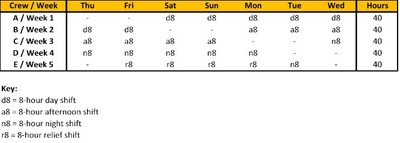


This is a 5-crew schedule that follows a 5-week schedule. Crew A begins the schedule in Week 1, Crew B begins in Week 2, and so on. When the crews finish their first week, they move down to the next week of the schedule. When they finish Week 5, they start the cycle over again with Week 1. All five crews are working the same 5-week schedule. It's just that they are always in different weeks of that pattern.

You'll note that the 5th week of the schedule has only one required shift: the Tuesday night shift. The prior four shifts are relief shifts. These can be used to cover absences or for training, maintenance, or special projects. The only downside is that it doesn't cover every day of the week. Had we adopted a schedule that averaged 42 hours a week, we could have had relief coverage for every day of the week.


Is it worth eliminating the overtime? Let's look at the numbers.

We eliminated 2 hours of overtime a week for every employee. That will reduce the costs by 7.5%.

          2 hours OT/week * 1.5 OT premium = 3 hours/week

          3 hours/week saved  / 40 hours/week = 7.5% savings

We also have gained 4 days of relief coverage each week. If the absence rate is 10% of the normal weekly hours of work, this will reduce costs another 8.6%.

          4 / 7 days of coverage/week * 10% absence rate * 1.5 OT premium = 8.57%

This means that the total savings is 16.1% (7.5% + 8.6% = 16.1%). However, we have increased the headcount by 25% by adding a fifth crew, which is far more than the 16.1% we saved.


Want to read more about 8-hour shift schedules? Here are links to several articles I've written:


Posted in Staffing, Overtime by Bruce Oliver
August 17th, 2014 at 10:56 pm   starstarstarstarstar      

Thieru,


It takes at least 4 people working an average of 42 hours a week to provide 1-person coverage on a 24/7 basis. If you try to cover around-the-clock without overtime, there will be an 8-hour gap in the coverage. Here's the math:


24/7 coverage:     24 hours/day * 7 days/week = 168 hours/week


4 people * 40 hours/week = 160 hours/week, whereas 4 people * 42 hours/week = 168 hrs/wk


With 4 supervisors, you can only use 3 shift lengths/formats:


1. 8-hour rotating shifts.

2. 12-hour rotating shifts

3. 12-hour fixed shifts.


Anything else will require 5-6 people (e.g., 10-hour shifts or 8-hour fixed shifts). My on-going argument against avoiding OT in the schedule is that it is often the cheapest solution. Supervisors are not eligible for overtime pay but, even if they were, the overtime premiums would be less expensive than hiring another supervisor (especially when you take the cost of benefits into account).


Sometimes you can create schedules that use 4 crews. Since your staff is not a multiple of 4 people, this probably won't work for you. You could always put one extra person on one crew. If you use a schedule with crews, you could put one supervisor on each crew. You didn't say what type of schedule the agents were working, so it's hard for me to give you much more direction than this.

Tiffany Perry says:
September 16th, 2014 at 5:56 pm   starstarstarstarstar      

Im having the hardest time starting a rotation for my staff that work 12hrs shifts. I 26 staff the work 7a-7p. I need 13 on a shift . Not sure where to start. I would like to give them every other weekend off. is this possible?

Taj Ali says:
October 8th, 2014 at 9:14 pm   starstarstarstarstar      

Dear Sir,


Greetings of the day,


Please giude me to make a schedule for 4 groups, 8hrs/day and 40hrs/week with 24/7 coverage. 

Nick Polisson says:
October 20th, 2014 at 11:33 pm   starstarstarstarstar      

Maybe you can help us i work in a Boiler room and they just hired a New Chief Engineer, his deal is that he only works 7:00 am - 3:30 pm monday thru friday there are only four of us to cover 24 hrs a Day and we are trying to get every other week end to spend time with our families. But the upper managment doesnt care about us but they only want to work 40 hrs in a week.


Do you have any suggestions


Nick

October 21st, 2014 at 9:52 am   starstarstarstarstar      

Nick,

There are three issues you have raised. The first is that management wants to cover 24/7 using 4 people but without using any overtime. My short reply is that this is IMPOSSIBLE. If you work four employees for only 40 hours a week, you get 160 hours of coverage (4 * 40 = 160). Yet 24/7 coverage requires 168 hours of coverage (24 * 7 = 168). You will always have 8 hours a week in which no one is scheduled to work. You may want to educate them about this misunderstanding.


The other issue is that the boss wants to work Monday through Friday from 7:00 a.m. to 3:30 p.m. Since this is an 8-hour shift, everyone else must work 8-hour shifts. With 8-hour shifts, the maximum weekends off is one every 4 weeks. Regardless of when the boss works, it is impossible to get every other weekend off - simply because you are working 8-hour shifts.


The final issue is that by giving the boss every weekend off, that means the rest of you will never get a weekend off. There are three shifts per day and three of you to work them. Since the boss is off every Saturday and Sunday, those three shifts have to be filled by the three other workers.


Each of these issues involves simple math. Trying to cover 24/7 with 4 employees and no OT can't be done. Trying to cover a 24-hour day when one person works a 8-hour shift requires everyone to work 8-hour shifts. Giving one of the four employees every weekend off leaves the three weekends shifts to be covered by the other 3 employees. These facts cannot be changed or mitigated. The only solution is to somehow enlighten management. That's why I write blog posts like this one. Unfortunately, the people who need to read it the most - don't.


Erika says:
October 30th, 2014 at 5:17 pm   starstarstarstarstar      

24/7 coverage, 40 hour work week, 9 people and 2 different spaces each requiring 24/7 coverage.

Brian W says:
November 7th, 2014 at 9:41 am   starstarstarstarstar      
derek says:
December 4th, 2014 at 12:36 pm   starstarstarstarstar      

Trying to create a 24/7 schedule with 10 employees, minimum coverage of 2 per shift.  Any help would be appreciated

December 4th, 2014 at 6:16 pm   starstarstarstarstar      

Derek,

It takes 8 people working an average of 42 hours a week to provide 2-person coverage on a 24/7 basis. You have 10 employees or 2 "extra" people. Some people might use this extra capacity to boost the coverage on one or more shifts. Others might use it to eliminate overtime from the schedule. I would use it to build relief coverage into the schedule to cover most/all the absences.

I would leave the overtime in the schedule. This would allow you maximum flexibility in using the relief coverage. It would also eliminate the need for overtime to cover any absences. If you use the extra capacity to eliminate overtime from the schedule, you lose some of the ability to reduce overtime for absence coverage.

You have three scheduling options: (1) 8-hour rotating shifts, (2) 12-hour fixed shifts, or (3) 12-hour rotating shifts. You can't use 8-hour fixed shifts with my approach because that would require 9 people just for the coverage and you would have only 1 extra person to create relief coverage on a single shift.

If you would like my help with the design of some schedules, please contact me. This is what do for a living.

Brittany says:
October 23rd, 2016 at 4:33 pm   starstarstarstarstar      

Hi, 


So I have 12 total employees on 1st and 2nd shift and 6 total employees for 3rd shift. We need 24/7 coverage, 40 hrs weeks and on 1st/2nd shift no more than 7 to 8 employees total working at a time with every other weekend off

Name * 
Email * 
Rate This Post  
Spam Protection