It's amazing how many people contact me about 24/7 schedules with no overtime in them. I warn them that this will not necessarily lower their costs. I also explain that avoiding overtime in the schedule will not eliminate the need for overtime. OT will still be needed to cover absences or temporary increases in demand. Here are links to two articles I've previously written on this subject:
It's best to think of overtime as a way to increase the size of your staff without adding to the headcount. A small amount of overtime in the schedule means you will need fewer employees to produce a specific amount of coverage. Overtime also can enable you to build relief coverage into the schedule to cover absences. In some cases, it's possible to reduce the total overtime by doing this (https://www.shift-schedule-design.com/Blog?m8:post=you-can-t-eliminate-overtime-but-you-might-be-able-to-reduce-it).
The bottom line is: if you eliminate overtime from the schedule, you will increase the staffing requirements. In most cases, the increased headcount will be more expensive than the overtime was.
Despite these words of warning, I know that some of you still want to see schedules with only 40 hour work weeks. Let's take a look at an example using 8-hour rotating shifts. If you want a 12-hour schedule without overtime, I suggest you read this other blog post here.
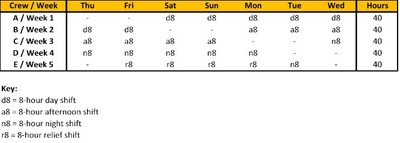
This is a 5-crew schedule that follows a 5-week schedule. Crew A begins the schedule in Week 1, Crew B begins in Week 2, and so on. When the crews finish their first week, they move down to the next week of the schedule. When they finish Week 5, they start the cycle over again with Week 1. All five crews are working the same 5-week schedule. It's just that they are always in different weeks of that pattern.
You'll note that the 5th week of the schedule has only one required shift: the Tuesday night shift. The prior four shifts are relief shifts. These can be used to cover absences or for training, maintenance, or special projects. The only downside is that it doesn't cover every day of the week. Had we adopted a schedule that averaged 42 hours a week, we could have had relief coverage for every day of the week.
Is it worth eliminating the overtime? Let's look at the numbers.
We eliminated 2 hours of overtime a week for every employee. That will reduce the costs by 7.5%.
2 hours OT/week * 1.5 OT premium = 3 hours/week
3 hours/week saved / 40 hours/week = 7.5% savings
We also have gained 4 days of relief coverage each week. If the absence rate is 10% of the normal weekly hours of work, this will reduce costs another 8.6%.
4 / 7 days of coverage/week * 10% absence rate * 1.5 OT premium = 8.57%
This means that the total savings is 16.1% (7.5% + 8.6% = 16.1%). However, we have increased the headcount by 25% by adding a fifth crew, which is far more than the 16.1% we saved.
Want to read more about 8-hour shift schedules? Here are links to several articles I've written:

 8:00am - 5:00pm (Central Time Zone), Mon-Fri
  (479)370-0902
